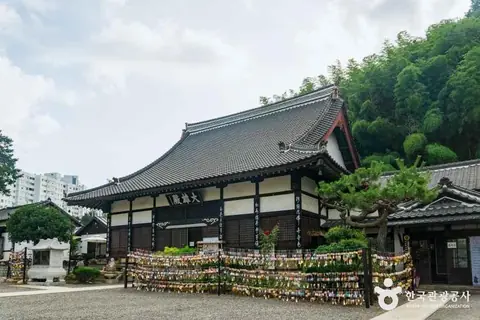
Dongguksa Temple is a Japanese-style Buddhist temple in Geumgwang-dong. It began in 1909 as Geumgangseonsa, a mission hall founded by Uchida, a monk of Japan's Soto school. In 1913 the main hall and monks' quarters were newly built on the current site, and in 1955 it was registered as Dongguksa Temple. The main hall, built in the Edo-period style, is Registered Cultural Heritage No. 64. The Shakyamuni Triad enshrined in the main hall is also designated cultural heritage.
Hours
[하절기]08:00~19:00[동절기]08:00~18:00 Original
Closed days
Open all year
Fees
Free
Parking
Not available
Sources: Gunsan City Culture and Tourism·Korea Tourism Organization TourAPI
Forecast by Korea Tourism Organization · received Oct 31
Crowd forecast: A relative forecast where 100 is this place at its busiest; not for comparing places. Quiet 0–39 · Moderate 40–69 · Busy 70 and over — bands set by this site
Sources: Hours and closed days: Korea Tourism Organization · Sunrise and sunset: calculated from the place's coordinates · Crowd forecast: Korea Tourism Organization
Dongguksa Temple before you go
Hours
[하절기]08:00~19:00[동절기]08:00~18:00 Original — source 1
Closed days
Open all year — source 1
Fees
Free — source 1
Parking
Not available — source 1
Contact
063-462-5366 Original — source 1
Address
전북특별자치도 군산시 동국사길 16(금광동) Original — source 2
1Korea Tourism Organization TourAPI
2Gunsan City Culture and Tourism
Dongguksa Temple photos 7
Dongguksa Temple2/7Source: Korea Tourism Organization · KOGL Type 1
Dongguksa Temple3/7Source: Korea Tourism Organization · KOGL Type 3 (no changes allowed)
Dongguksa Temple4/7Source: Korea Tourism Organization · KOGL Type 3 (no changes allowed)
Dongguksa Temple5/7Source: Korea Tourism Organization · KOGL Type 3 (no changes allowed)
Dongguksa Temple6/7Source: Korea Tourism Organization · KOGL Type 3 (no changes allowed)
Dongguksa Temple7/7Source: Korea Tourism Organization · KOGL Type 3 (no changes allowed)
Source: Korea Tourism Organization · KOGL Type 1, KOGL Type 3 (no changes allowed)
Dongguksa Temple more information
Website
https://tour.gunsan.go.kr/tour Original — source 1
Dongguksa Temple facilities and access
Stroller rental
None — source 1
Dongguksa Temple map
The places on this map are also listed on this page. Coordinates 35.9829030983, 126.7075713729
The beginning of Dongguksa Temple: Geumgangseonsa, a mission hall founded in 1909 by Uchida, a monk of Japan's Soto school
Dongguksa Temple grew out of Geumgangseonsa (Geumgangsa), a mission hall founded in August 1909. Its founder was Uchida, a monk of Japan's Soto school. Its first site was on the 1-jo street of Gunsan's foreign settlement. The main hall and monks' quarters were newly built on the current site in 1913. Donations from 29 followers, including large Gunsan landowners such as Kumamoto and Miyazaki, made this possible, and the main hall's building materials came from Japan.
Dongguksa Temple got its name in 1955, when Kim Nam-gok registered it
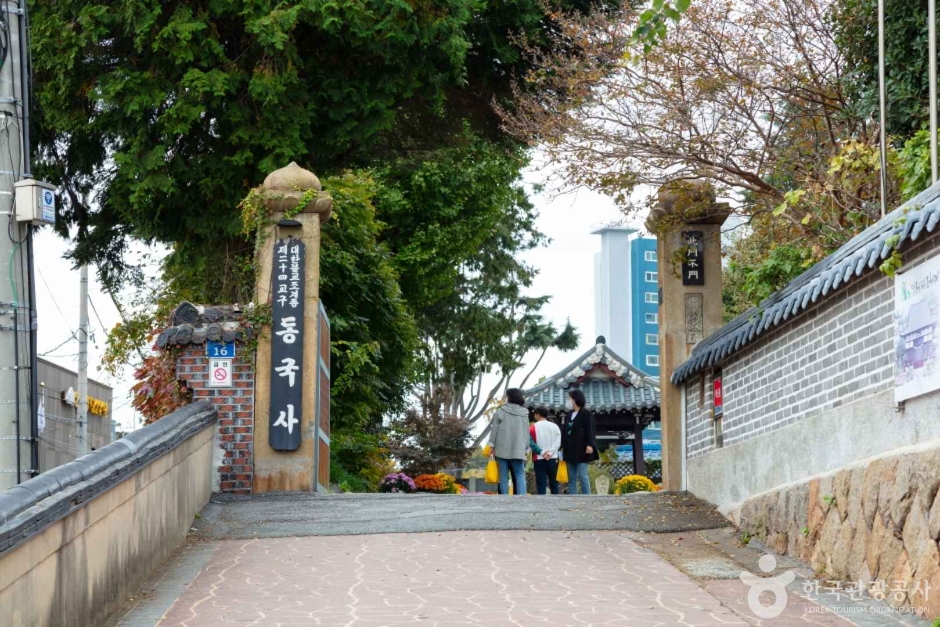
The name Dongguksa Temple was given when Kim Nam-gok (1913–1983) registered the temple after the Jeonbuk Buddhist administrative office took it over in 1955. It means 'from now on, a temple of our country (Haedongguk).' Before that, at liberation in 1945, the US military government confiscated the temple. In 1947 it was bought in a government sale and run as a temple again. In 1970 it was registered under Seonunsa Temple, the 24th parish of the Jogye Order of Korean Buddhism.
Dongguksa Temple main hall style: Japanese Edo period, 5 bays wide and 5 bays deep, 75-degree roof pitch
The Dongguksa Temple main hall is a square, single-story building (5 bays across the front and 5 bays on the side). It follows the architectural style of Japan's Edo period, and its roof is a hip-and-gable roof with single eaves. The roof slopes steeply at up to 75 degrees, the ridge is a straight line, and the outer walls have many windows, unlike a hanok. It also differs from traditional Korean temples in that a corridor connects it to the quarters where the monks live.
Dongguksa Temple heritage status: Registered Cultural Heritage No. 64; the Shakyamuni Triad is Jeollabuk-do Tangible Cultural Heritage No. 213
Dongguksa Temple is Registered Cultural Heritage No. 64, registered by the Cultural Heritage Administration on July 15, 2003. The Shakyamuni Triad enshrined in the main hall is separately designated as Jeollabuk-do Tangible Cultural Heritage No. 213.
Videos·Articles from abroad·Blog posts
Japan left these temples behind in Korea — and Koreans kept them
It is a Japanese-style temple that began as Geumgangseonsa, a mission hall founded in 1909 by Uchida, a monk of Japan's Soto school. In 1913, donations from 29 followers paid for a new main hall and monks' quarters on the current site. In 1955, Kim Nam-gok registered it as Dongguksa Temple, a name meaning 'a temple of our country (Haedongguk).'
How is the Dongguksa Temple main hall different from traditional Korean temples?
It differs from traditional temples in that a corridor connects it to the quarters where the monks live. It was built in the Edo-period style with materials brought from Japan. The roof is steep at 75 degrees, the ridge is a straight line, and the outer walls have many windows. It is 5 bays across the front and 5 bays on the side.
Were any movies filmed at Dongguksa Temple?
Yes. Christmas in August (1998) and Once Upon a Time in High School (2004) were filmed here.
Until what time can you visit Dongguksa Temple?
You can visit 08:00–19:00 in summer and 08:00–18:00 in winter, and it is open all year. Admission is free, and parking is not available.
Is Dongguksa Temple a registered cultural heritage site?
Yes. It is Registered Cultural Heritage No. 64, registered on July 15, 2003. The Shakyamuni Triad enshrined in the main hall is also separately designated as cultural heritage.
What does the name Dongguksa Temple mean?
It means 'a temple of our country (Haedongguk).' In 1955, Kim Nam-gok registered the temple under the name Dongguksa Temple with this meaning.
Which Buddhist order does Dongguksa Temple belong to?
It belongs to the Jogye Order of Korean Buddhism. In 1970 it was registered under Seonunsa Temple, the 24th parish of the Jogye Order.
Is the Dongguksa Temple Shakyamuni Triad designated cultural heritage?
Yes. The Shakyamuni Triad enshrined in the main hall is Jeollabuk-do Tangible Cultural Heritage No. 213.







 Sandeulstraight-line 98m